
Rooted Sangha: The Bhagavad Gita | Chapter 1 - The War Within
Updated: Mar 9
This week in sangha, we continued discussing The Bhagavad Gita for Daily Living by Eknath Easwaran. Each week, I will attempt to summarise the parts of the book we discuss. Please refer to https://www.sjholisticyoga.co.uk/post/what-is-the-bhagavad-gita if you need a grounding in what The Bhagavad Gita is.
Chapter 1: The War Within
The Gita is not a historical discourse...It is the description not of war between cousins, but between two natures in us.
Mahatma Gandhi.
From short-term comfort to lasting good
Chapter 1 sets the tone for the journey ahead. We begin to see that freedom from the ego does not come through a single insight or decisive moment, but through a long and patient practice. This is not a battle to be won quickly. It is a gradual reorientation of how we respond to ourselves and the world.
Rather than eradicating parts of ourselves, the work is one of transformation. We learn, over time, to soften anger into compassion, to meet fear with courage, and to turn greed into a genuine concern for the welfare of others.
The ancient Sanskrit texts describe this choice through the concepts of preya and shreya.
Preya refers to what feels immediately pleasing to the senses, but quickly fades and often leads to its opposite. We choose preya when we indulge habits that harm us, when we react impulsively, or when we seek short-term relief at the cost of long-term well-being. It offers comfort in the moment, but carries a hidden price.
Shreya, by contrast, is the good that leads to lasting welfare. It is what we choose when we cultivate healthier patterns, when we pause rather than retaliate, when we seek understanding over victory, and when we consider the well-being of the whole rather than our own immediate comfort.
This is the quiet, ongoing work the Gita invites us into. Not dramatic self-conquest, but a steady practice of choosing what truly sustains us, again and again.
What lasts and what passes
Another pair of Sanskrit terms offered by the tradition are nitya and anitya.
Nitya refers to that which is enduring and unchanging. We move towards nitya when we act from qualities that have depth and continuity: when we forgive those who have caused harm, when we remain open to people who see the world differently from us, and when we choose responses that widen rather than narrow our sense of connection.
Anitya, by contrast, refers to that which is temporary and fleeting. We turn towards anitya when we give ourselves over to reactive anger, or when we act in ways that inflate the self at the expense of others. These choices may offer a brief sense of satisfaction or control, but they quickly dissolve, often leaving discomfort or regret behind.
The Gita is clear that conflict driven by reactivity harms both sides. Yet it also makes a subtle distinction. When we stand against what is grasping, impulsive, or self-willed within ourselves, we are not creating harm. We are clearing space for something more stable to emerge.
In this way, the work is not about opposing others, but about aligning ourselves with what endures. When we choose what is lasting over what is momentarily pleasing, the effect reaches beyond us, bringing a deeper and more reliable sense of ease to the whole.
When the body speaks before the mind
Arjuna says:
“O Krishna, I see my own relations here with the desire to fight, and my limbs are weak; my mouth is dry, my body is shaking, and my hair is standing on end.”
Arjuna is confused and paralysed with fear. Although he deplores this state of inertia and self-pity, he cannot rid himself of it. His mind reels at the prospect of fighting, and he begins to realise that the battle he must wage is not external, but against what he has always considered to be a part of himself.
Eknath reminds us that “one of the best definitions of confusion is doing what is unnecessary and failing to do what is necessary. As we progress on the spiritual path, our vision begins to clear and our passions begin to come under our control. We discover that we have been pursuing agitation instead of joy and accumulation instead of security.”
Arjuna continues to despair at the violence and disharmony in the world. Yet this despair is not dismissed or silenced. Eknath reminds us that “even one person standing against violence, whether it is in the home, in the community, or between nations, can become a source of inspiration for everyone.”
In this way, Arjuna’s trembling is not a weakness to overcome, but a very relatable moment of truth. His body reveals what the mind has not yet been able to name. The pause itself becomes the beginning of discernment.
Returning to what steadies us
Eknath says:
'When we meditate every morning we are putting on armour for our daily battle against our own impatience, inadequacy, resentment , and hostility.'
Meditation, in this sense, is not an escape from life, but a quiet preparation for it. Each time we sit, we are choosing to meet the day from a place of steadiness rather than reactivity. We are not armouring ourselves against the world, but against the habits that pull us away from clarity and care.
Through meditation, we begin to reconnect with what the Gita calls the,. Not the self shaped by past mistakes, old stories, or momentary emotions, but the part of us that remains whole and untainted beneath it all. This Self is not something we have to improve or perfect. It is already here, waiting to be remembered.
Over time, meditation helps us respond rather than react. It creates a small but meaningful space between what happens and how we meet it. From that space, patience becomes possible. Compassion becomes more accessible. Even in the midst of difficulty, we are less likely to abandon ourselves.
This is why the practice matters, not because it makes life smooth or painless, but because it helps us return, again and again, to the place within us that knows how to meet life with integrity.
This week, I invite you to find even a few minutes in the morning to meditate. You might like to be guided by this video, it is less than 6 minutes in length.
Journal/Thinking prompts
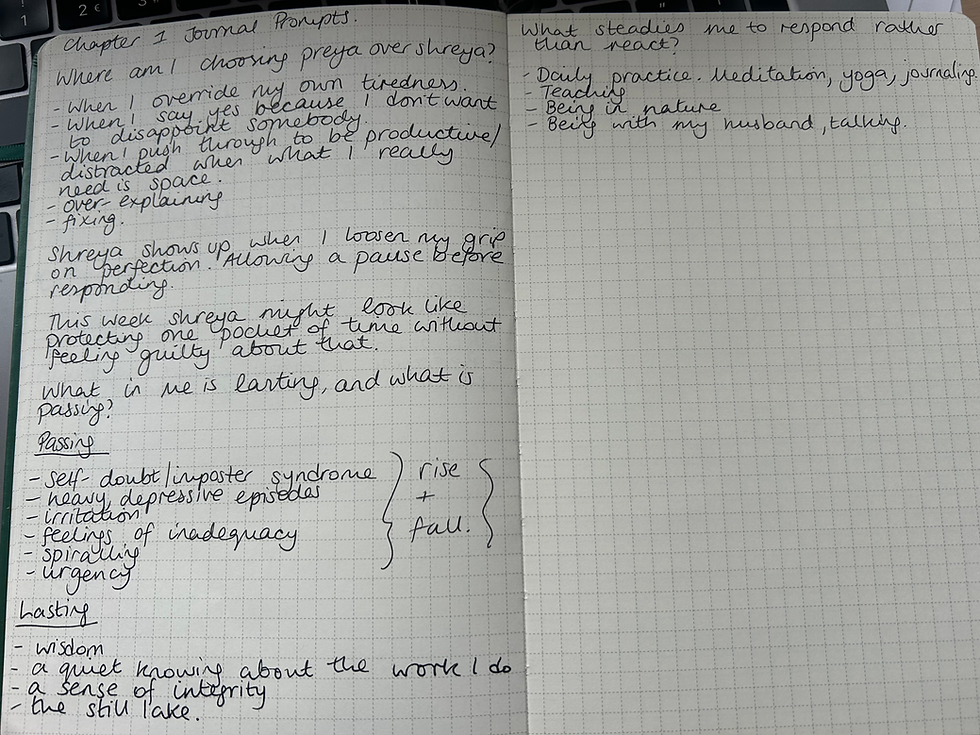
Where are you choosing preya over shreya?
What might choosing shreya look like instead, not dramatically, but in one small, steady way this week?
What in you is lasting, and what is passing?
When you are caught in irritation, fear, or self-doubt, what part of you feels temporary and reactive?
Beneath that, is there something steadier, quieter, more enduring?
How might you act from that place more often?
What steadies you enough to respond rather than react?
What helps you return to yourself when impatience, resentment, or inadequacy begin to rise?
How might you gently strengthen that daily practice, so that you are meeting life from your deeper Self rather than from habit?
Giving Back
After covering room and fuel costs, all proceeds from Rooted are being saved to support a local cause, to be chosen together later this year - as a small act of Bhakti yoga, the yoga of devotion in action.
On 21st September, we made our first donation (£110) to Kettering Samaritans.
On 23rd December, we donated £100 to Johnny's Happy Place, a wonderful mental health support cafe in Kettering.
We agreed that our next beneficiary will be The Green Patch, Kettering. There is currently £60 in the pot!
Going Forward
Next week we will start to look at Chapter 2. If you would like to join us in person - do get in touch or book online. If you would like to buy the book, click the image below for options.

With love,
Vicki x


Comments