
The Books That Nourished Me This Year (and How They Might Have Shaped My Teaching)
This year, I read more than seventy books ,fiction and non-fiction, and each one left something behind. Some offered language. Some softened me. Some unsettled me in ways that later felt essential.
What follows isn’t a comprehensive list, but a shortlist of books that will stay with me forever. These are the ones that didn’t just inform me, but worked on me - shaping how I think, how I teach, and how I hold space. In no particular order:

If Women Rose Rooted — Sharon Blackie
This book felt like a remembering.
It deepened my trust in place, myth, ancestry, and the cyclical intelligence of women’s lives. It affirmed something I already sensed in my teaching: that people are not hungry for more techniques, but for belonging - to land, to story, to themselves.
As a yoga teacher, it strengthened my commitment to teaching in a way that is rooted rather than aspirational, grounded rather than transcendent. It reminded me that wisdom doesn’t live “above” the body, but within it.

Wise Power — Alexandra Pope & Sjanie Hugo Wurlitzer
Wise Power was pivotal.
It reframed menopause not as a decline, but as an initiation - a profound shift into discernment, authority, and embodied truth. Because of this book, I undertook two menopause trainings: one yoga-specific, and one not.
As a teacher and circle facilitator, I found the language and the confidence to honour this life stage openly and without apology. It sharpened my ability to hold space for women navigating change, anger, grief, clarity, and power - without trying to soothe or fix what is actually a rite of passage.

Hags — Victoria Smith
Sharp, funny, and quietly furious.
Hags gave language to something many women feel but struggle to articulate - the cultural discomfort with ageing women who no longer centre themselves around being pleasing, useful, or palatable. It reminded me that irritation can be instructive, and that clarity is not unkind.
In my teaching, this translated into firmer boundaries, clearer language, and less emotional labour where it wasn’t appropriate. Not hardness - honesty.

The Courage to Be Disliked — Ichiro Kishimi & Fumitake Koga
This book genuinely changed my life.
Its exploration of Adlerian psychology challenged many deeply held assumptions about approval, responsibility, and freedom. It helped loosen my attachment to being liked - by students, peers, or the wider yoga world - and replaced it with a steadier sense of internal authority.
As a teacher, this has been transformative. I’m less reactive, less apologetic, and far more grounded in my values. Teaching feels cleaner when it’s not shaped by the need for external validation.
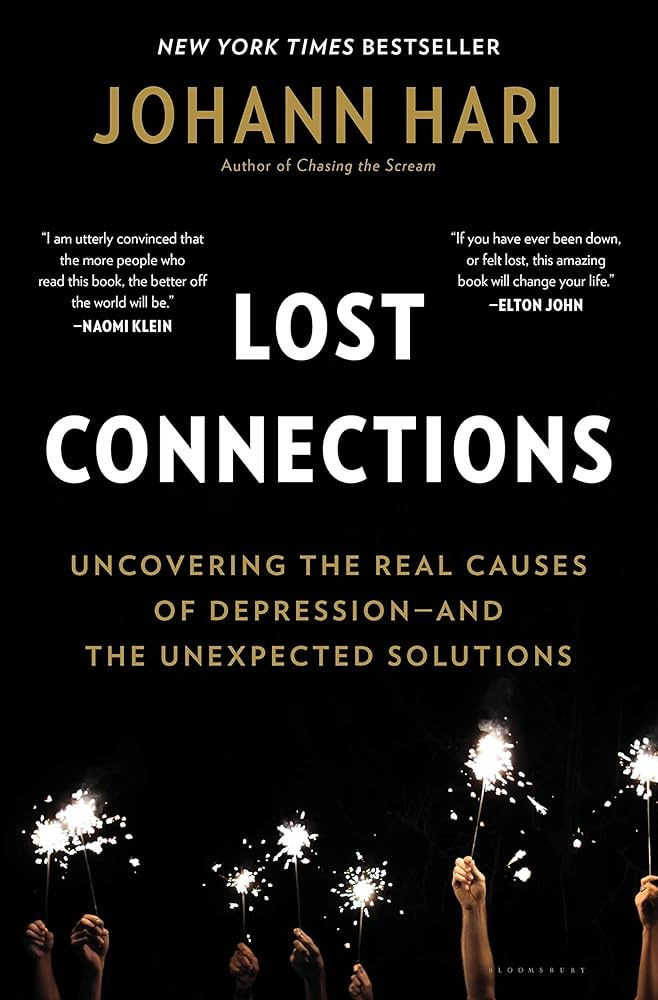
Lost Connections — Johann Hari
This book expanded my understanding of mental health beyond the individual.
Lost Connections reinforced what yoga has always pointed towards: that distress often arises from disconnection - from meaning, community, purpose, and agency. It strengthened my belief that yoga is not just about calming the nervous system, but about restoring relationship - with self, others, and the world.
It encouraged me to keep teaching in ways that prioritise connection over correction.

A Hunter in a Farmer’s World — Thom Hartmann
This is essential reading for anyone who is neurodivergent, or loves someone who is.
It reframed ADHD not as a deficit, but as a difference - one that makes sense when viewed through a wider evolutionary and cultural lens. As a yoga teacher, it reinforced the importance of flexible teaching, multiple entry points, and compassion for nervous systems that don’t thrive in rigid structures.
It also deepened my understanding of my own rhythms and my refusal to force myself into systems that don’t fit.

Remarkably Bright Creatures — Shelby Van Pelt
Gentle, surprising, and quietly wise.
This novel reminded me that connection doesn’t always arrive in the ways we expect - and that tenderness can be a form of strength. It softened me, which matters more than we often admit.
Softening is not the opposite of strength in teaching. It’s what allows presence.

The Island of Missing Trees — Elif Shafak
This book changed the life of my little fig tree. And that might sound small, but it isn’t.
Through its storytelling, it made me feel the intelligence, memory, and quiet witnessing of the natural world. It brought tenderness to something I had previously overlooked - a neglected potted fig tree that I now regard with care and attention I didn’t know I was capable of.
As a yoga teacher, it reaffirmed the power of attention. What we notice, we tend. What we tend, changes us.

No Bad Parts — Richard C Shwartz
No Bad Parts is grounded in Internal Family Systems and begins with a simple but radical premise: there are no bad parts within us, only parts that have learned extreme roles in order to protect us. Rather than trying to fix or override these parts, the work invites curiosity, compassion, and relationship. Reading this softened the way I hold both myself and others.
It deepened my patience, expanded my capacity for non-judgement, and reinforced something yoga has always pointed towards - that healing doesn’t come from force, but from meeting what’s here with steadiness and care.
I carry this understanding directly into my teaching, holding a quiet awareness that each student arrives with many inner parts, stories, and coping strategies moving beneath the surface. My role is not to fix or manage that complexity, but to create a space where it can be met safely, without judgement, and without needing to be pushed away.
It also reminds me of the wonderful Rumi, and his work 'Guest House'

The Mad Women’s Ball — Victoria Mas
Disturbing, beautifully written, and hard to forget.
This novel stayed with me for its exploration of power, sanity, and what happens when women’s voices are dismissed or controlled. Not an easy read - but an important one.

The Book of Guilt — Catherine Chidgey
Quietly unsettling and psychologically sharp, this book lingered long after I finished it. It explores control, obedience, and moral complexity in a way that feels both restrained and deeply uncomfortable - often where the most meaningful reading lives.
Both of these last two books reinforced my commitment to creating spaces where women are not analysed, fixed, or silenced, but listened to and trusted. It deepened my awareness of how important it is to honour emotional expression, bodily autonomy, and inner authority - and to recognise that what is labelled as disorder or excess is often a response to being unheard.
I read many more books this year - some enjoyable, some forgettable, some simply right for the moment. But these are the ones that will stay with me. The ones that fed my thinking, softened my edges, sharpened my discernment, or gently changed the way I see the world.
Reading, for me, isn’t about consumption. It’s about companionship. About letting other voices walk alongside mine for a while, and noticing what shifts as a result.
If even one of these finds its way to you at the right moment, then it’s done its work again. I would love to hear your book recommendations so I can add them to my ever-growing TBR pile!


Comments