
Rooted Sangha: The Bhagavad Gita Introduction
Updated: Feb 6
This week in sangha, we started our new book: The Bhagavad Gita for Daily Living by Eknath Easwaran. Each week, I will attempt to summarise the parts of the book we discuss. Please refer to https://www.sjholisticyoga.co.uk/post/what-is-the-bhagavad-gita if you need a grounding in what The Bhagavad Gita is.

Chapter: Introduction
The battlefield within
Bhagavad Gita opens on a battlefield, but it does not stay there for long.
Very quickly, the dust and armour begin to feel symbolic. The noise of war gives way to something quieter and far more intimate: a human being frozen by inner conflict. This is one of the reasons the Gita continues to speak across centuries. It is not really about war at all. It is about what happens inside us when life asks something difficult, costly, or unfamiliar.
The battlefield as inner terrain
The opening scene of the Gita is set on a battlefield, but from the very beginning, this setting invites symbolic reading. Kurukshetra is not only a physical place. It is the field of consciousness where everything that shapes a human life gathers at once.
Fear, duty, love, loyalty, memory, habit, courage, doubt.
Rather than a simple struggle between good and evil, this is a meeting of competing inner forces. The kind we recognise when life asks something difficult of us and there is no easy answer.
The people on the battlefield
Arjuna looks out and sees teachers, elders, friends, cousins. Those he loves. Those he owes his sense of self to. Symbolically, these figures can be read as aspects of Arjuna’s own inner world:
long-held beliefs and conditioning (see also samskaras)
loyalties shaped by family, culture, and history
roles that once offered safety and belonging
parts of the self that are familiar, even when they no longer serve
This is not a simple struggle between good and evil. It is a far more human tension. One that lives inside us all. The opposing forces might look like courage and fear, impulsivity and discernment, greed and selflessness, attachment and integrity. None of these qualities are inherently “bad”. Many once had their place. The conflict arises when they pull in different directions at the same time.
This is why Arjuna’s collapse is so visceral. He is not being asked to defeat enemies. He is being asked to confront the internal structures that have shaped who he is.
Why Arjuna can't move
Arjuna’s collapse is often mistaken for weakness. Seen through Easwaran’s lens, it looks more like intelligence. His body refuses to act because unconscious habit can no longer carry him forward. Action without clarity would mean betraying something essential within him. Stopping becomes a form of honesty.
In this way, the Gita opens not with heroism, but with listening.
Krishna’s place in the story
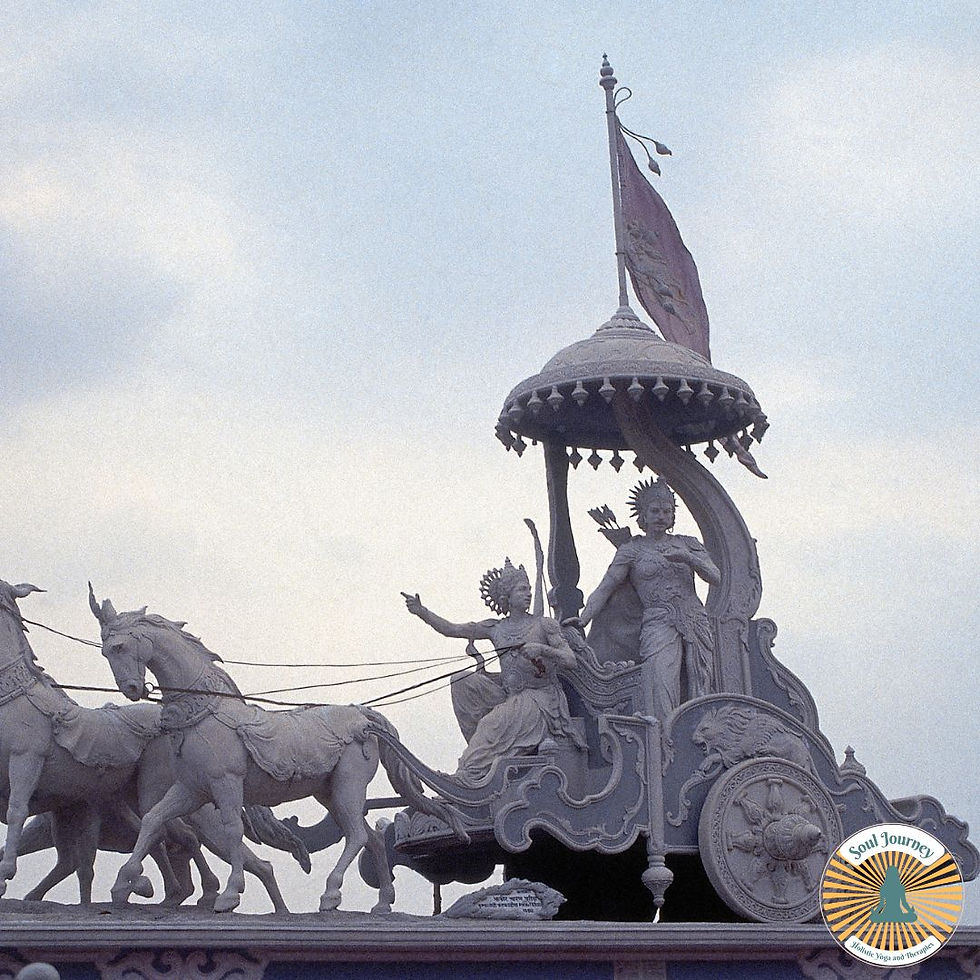
Krishna stands outside the two armies. He does not belong to either side.
Symbolically, Krishna represents the witness consciousness – the capacity to see clearly without being overtaken by fear, guilt, or attachment. In yogic language, this is buddhi: discernment that arises when we pause long enough to observe rather than react.
Krishna does not remove Arjuna’s conflict. He helps him learn how to see the whole field, inwardly and without avoidance.
Why this matters to us
Most of our battles are quiet ones.
They appear as tensions between responsibility and self-care, truth and belonging, who we have been and who we are becoming. The Gita does not suggest we escape these moments. It asks us to meet them with patience, clarity, and compassion.
Perhaps the real question the Gita poses is not 'What should I do?' but 'Can I see clearly enough to act without self-betrayal?'
Journal/Thinking prompts
Where do you notice inner conflict in daily life, and what changes if that conflict is met with curiosity rather than judgment?
Easwaran speaks of freedom as an inner quality rather than something dependent on circumstances. What does inner freedom mean to you, in real, everyday terms?
The introduction of Easwaran's book emphasises practice and patience over quick transformation. What helps you keep returning, even when progress feels slow or unclear?

A Loving Kindness practice will sit beautifully alongside your reading of this book, and you can find many guided practices online. Here is one of mine.
Giving Back
After covering room and fuel costs, all proceeds from Rooted are being saved to support a local cause, to be chosen together later this year - as a small act of Bhakti yoga, the yoga of devotion in action.
On 21st September, we made our first donation (£110) to Kettering Samaritans.
On 23rd December, we donated £100 to Johnny's Happy Place, a wonderful mental health support cafe in Kettering.
We agreed that our next beneficiary will be The Green Patch, Kettering. There is currently £55 in the pot!
Going Forward
Next week, we will start to look at Chapter 1. If you would like to join us in person, do get in touch or book online. If you would like to buy the book, click the image below for options.

With love,
Vicki x


Comments