
Brigid and Imbolc: Tending the First Fire of the Year
Updated: Jan 30
Imbolc arrives quietly on 1st February, bringing the light of the full moon with it.
Not with the drama of solstice darkness or the riot of Beltane bloom, but with a subtler promise. Snowdrops pressing through frozen soil. The days slowly, gently lengthening. A sense, felt more than seen, that life is stirring again.
At the heart of Imbolc stands Brigid – luminous, many-layered, impossible to pin down to a single role or meaning. She is a goddess of thresholds and beginnings, of hearth and forge, poetry and prayer. She belongs as much to the home as to the wild places. There are more stories about Brigid than I could write in a day. And at Imbolc, she walks close.

The Triple Brigid: Three Sisters, One Flame
In early Irish tradition, Brigid is often described not as one goddess but as three sisters sharing the same name. A triple deity, reflecting a worldview where power is multiplied through relationship rather than divided into parts.
The three Brigids are commonly understood as:

Brigid of poetry and inspiration – keeper of words, song, and sacred speech
Brigid of healing – guardian of wells, remedies, and restoration
Brigid of smithcraft – mistress of fire, transformation, and making
These are not separate figures so much as different faces of the same fire. Creativity heals. Healing transforms. Transformation gives rise to new stories. Brigid reminds us that nothing meaningful exists in isolation.
At Imbolc, this triune nature matters. This is a festival of becoming, of potential just beginning to shape itself. We do not yet know what will grow, only that something is alive.
Brigid the Fire Goddess: Cormac’s Vision
While Brigid is often associated with wells and healing waters, some of the earliest written sources emphasise her fiery nature.

Cormac mac Cuilennáin, a 9th-century scholar and bishop, described Brigid as a goddess of poets whose inspiration was fire in the head. Not a gentle warmth, but a kindling blaze. The fire of insight, craft, and illumination.
This fire is not destructive. It is the fire that refines.
The forge fire that reshapes metal.
The hearth fire that feeds and warms.
The inner fire that calls us to make, to speak, to act.
At Imbolc, candles are lit not to banish darkness entirely, but to remind us that even the smallest flame changes everything.
Kildare and the Ever-Burning Flame
One of the most enduring expressions of Brigid’s fire lived at Kildare, where a sacred flame was tended for centuries.
According to tradition, nineteen women guarded Brigid’s fire, each taking a turn. On the twentieth night, Brigid herself was said to tend it. No man was permitted to cross the hedge that surrounded the flame. This was a place of female guardianship, devotion, and continuity.

When Christianity took hold, Brigid did not disappear. She transformed. The goddess became Saint Brigid of Kildare, and the flame continued to burn in the care of nuns until it was extinguished in the 16th century.
In 1993, the flame was rekindled.
That continuity matters. It speaks of a spiritual lineage that refuses erasure. Brigid’s fire adapts, but it does not go out.
You can learn more here: https://brigidine.org.au/about-us/our-patroness/brigids-light-fire/
Brigid of the Hearth
Perhaps the most intimate aspect of Brigid is her presence at the hearth.
This is not the grand fire of ritual alone, but the everyday fire: the one that cooks, warms, and gathers people together. Brigid is the goddess who understands domestic labour as sacred. She blesses the ordinary acts that keep life going.
At Imbolc, people traditionally cleaned their homes, prepared special foods, and laid out cloth or ribbon for Brigid to bless as she passed by in the night. These were small gestures, rooted in care rather than spectacle.
Brigid does not ask for extravagance. She asks for attention.
Brigid’s Well: Where Fire Meets Water
If the hearth is where Brigid dwells, then the well is where she listens.

Across Ireland, holy wells dedicated to Brigid dot the land, but the most renowned is St Brigid’s Well, Kildare, close to the abbey and the sacred flame. Fire and water held in deliberate proximity. Not opposites, but companions.
This pairing matters deeply. Brigid’s power is not one-note. She does not burn without also soothing. Her fire is tempered by water; her water warmed by fire.
The well is a place of healing, blessing, and prayer. Traditionally, people would walk the well in ritual patterns, offer ribbons or cloths to nearby trees, and carry away water for the sick or sorrowing. The water was not seen as magical in itself, but as attuned and held within a sacred relationship.
In Celtic cosmology, wells are thresholds. They sit between worlds.
They are places where the unseen rises close to the surface, where memory, ancestry, and spirit pool together. To approach a well is to approach with humility. You do not take; you ask.
Brigid’s wells were especially associated with:
women’s health and fertility
recovery from illness
clarity of mind and heart
protection for children and animals
And always, always, with gentle persistence rather than dramatic intervention. The healing of the well is slow. Seasonal. Trust-based.

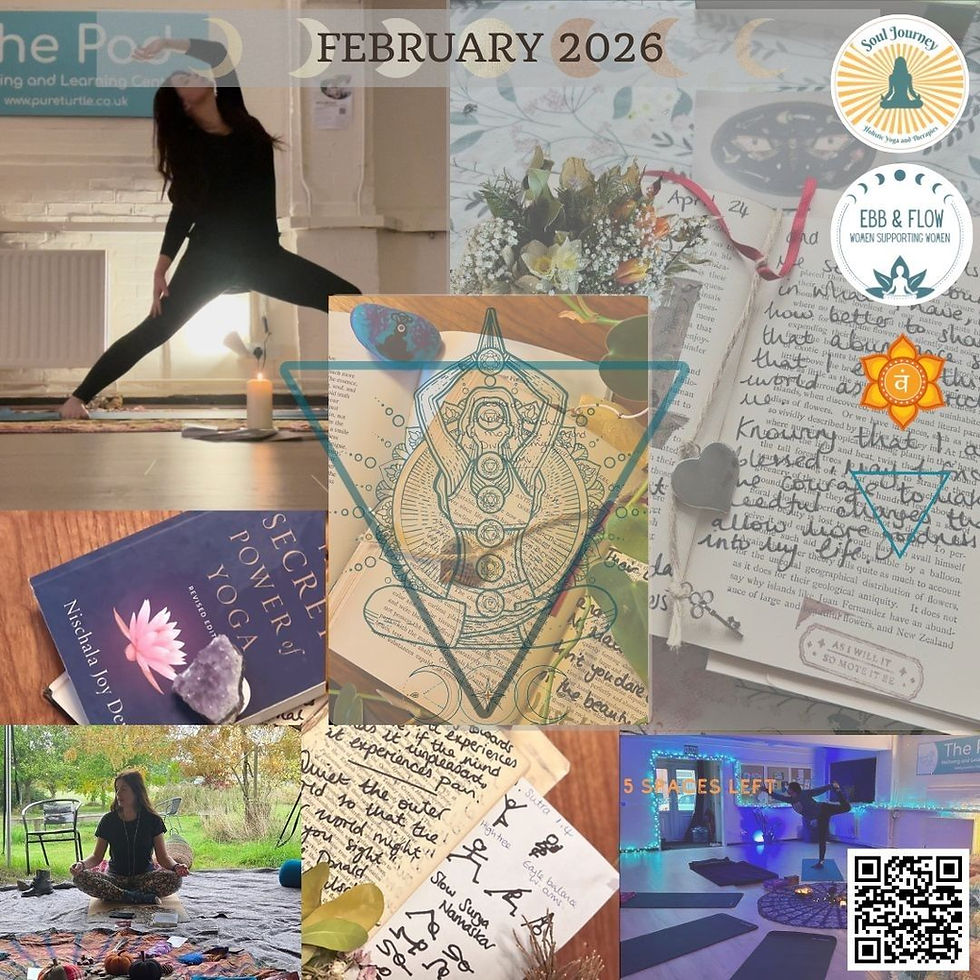
I always associate Svadisthana, the sacral chakra, with Brigid. For me, and this is a personal felt-sense, it is a marriage of water and fire (depending on the internal wheel of my cycle). A place of creativity and creation, of feelings and hidden depths. So when I cleanse my altar and decorate it for Imbolc, I bring in objects that connect me to my sacral chakra and meditate around that theme.
Imbolc as Inner Threshold
Imbolc is a threshold festival. We are still in winter, yet something has shifted. The days lengthen almost imperceptibly. Hope does not shout; it whispers.
Brigid teaches us how to meet this moment.
Not by rushing ahead.
Not by demanding clarity too soon.
But by tending what is already alive.
What small flame are you carrying right now?
What wants warming rather than pushing?
What quiet devotion might shape the months ahead?
At Imbolc, we do not need to know the whole story. We only need to keep the fire.
If you would like to explore this through gentle movement, breathwork and meditation, I have recorded an Imbolc-themed yoga practice.



Comments